
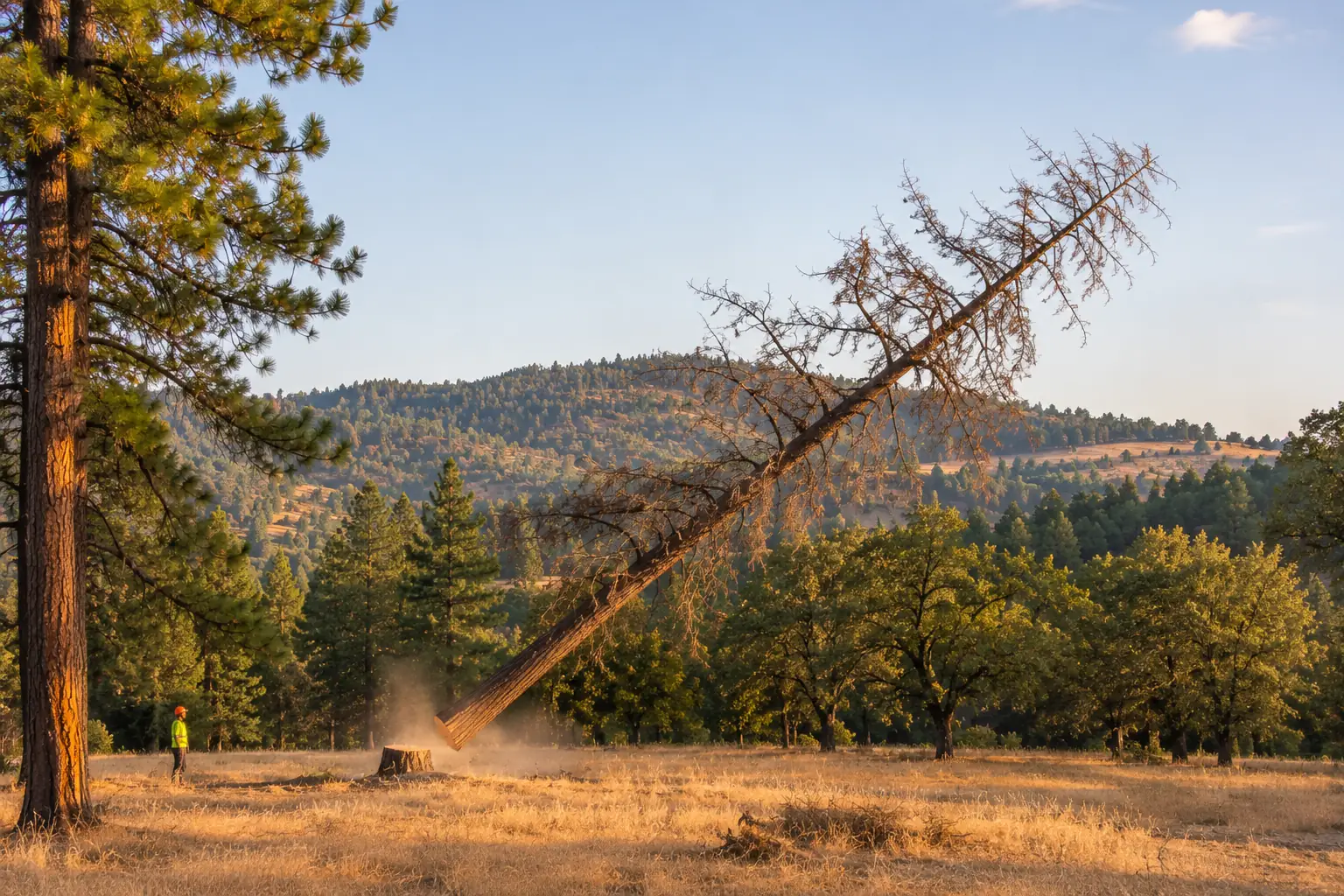
Tree removal in Rogue River is the right choice when a tree is dead, failing, crowding a house or in the way of a building plan, and trimming will not fix it. A free call to (541) 855-3193 connects you with one independent tree service holding an Oregon CCB license. Ask it to walk the site and put the removal price in writing, and confirm on the call that the estimate visit is free, as it usually is for a routine removal.
Removal or something less
Removal is final, so it helps to rule out the smaller fixes first. A tree with one bad limb may only need that limb cut. A tree shading a garden may only need its crown thinned. The trimming page explains those options.
Removal usually makes sense when:
- The tree is dead, or most of the crown has died back.
- The trunk is split, hollow or rotting at the base.
- Roots have heaved on one side and the tree has started to lean.
- The tree stands where a house, shop, well or driveway is going in.
- A pine is losing needles from the top down after a dry summer. The bark beetle guide covers what to look for.
If you are not sure, ask for a tree service that has an ISA Certified Arborist on staff, or one who holds ISA's Tree Risk Assessment Qualification, and ask them to tell you whether the tree can stay.
Three ways a crew takes a tree down
How a tree comes down depends on how much open ground sits around it. Expect the estimate to name one of these methods.
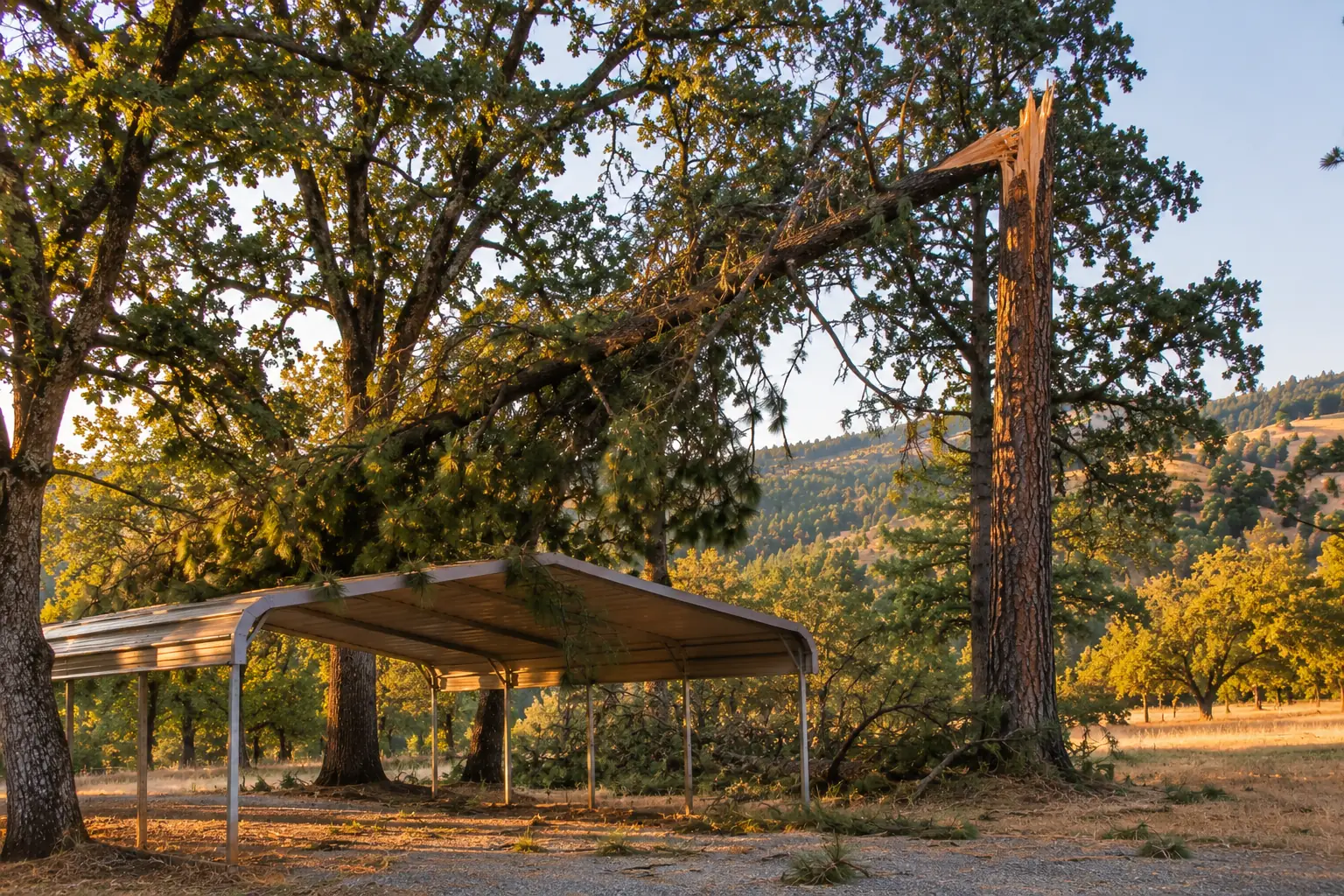
- Felling in one piece. On open acreage, a faller notches the trunk and drops the whole tree into a clear area. It is the fastest method and usually costs less than the others, but it needs a landing zone about as long as the tree is tall, with no fence, power line or building in the way.
- Sectional removal. Near a house or shop, a climber works down the tree, cutting the crown and then the trunk in short pieces. Heavier pieces are tied off and lowered on ropes so they do not hit the roof. It takes longer and costs more.
- Crane removal. For a very large tree leaning over a structure, a crane can lift sections away. This needs a place to park the crane on firm ground, which can be hard on a sloped rural lot.
Ask which method the company plans and why. Two bids that look far apart often use different methods.
Before removal day: a short checklist
Getting a few things ready makes the visit faster and safer.
- Move vehicles, trailers, outdoor furniture and potted plants out of the work area.
- Mark the septic tank, drainfield, well head and any buried water or power lines to outbuildings.
- Tell the company about gates, low wires or weak bridges on the way in.
- If a wire runs through or near the tree, ask Pacific Power about the free temporary service disconnect described on its tree page. Its customer service number for that request, which is not an emergency line, is 1-888-221-7070.
- Talk to the neighbor if the tree is near the property line or branches hang over their side.
Rules that can apply around Rogue River
Most trees on private land outside the creek corridors can be removed without a city permit, but three sets of rules come up often here. Confirm anything that affects your lot with the city or county before the work starts.
Street and park trees inside the city
The Rogue River street tree ordinance, Chapter 12.20, says no tree may be removed from a public parking strip or other public place without the street tree committee's permission (section 12.20.020). It also says the stumps of street and park trees must be taken down below the ground surface (section 12.20.180). City Hall is at (541) 582-4401.
Trees near the Rogue River and the creeks
The city's riparian chapter protects a strip 75 feet back from the top of the Rogue River's bank and 50 feet back from Evans Creek, Wards Creek and other fish-bearing streams. Section 17.135.040 says the city reviews requests to remove hazardous trees in that strip except in emergencies, may require an arborist's finding at the owner's expense, and requires native replacement trees. The Jackson Soil and Water Conservation District's city guide reads that as three native trees planted for each hazard tree taken out. In unincorporated Jackson County, the Soil and Water Conservation District's county guide gives the same 75 and 50 foot distances and says removing healthy trees there needs prior approval. The district can be reached at (541) 423-6159, and it gives guidance only, not permits.
Fire season
From the start of fire season (May 15 in 2026, according to the ODF announcement), ODF's Southwest Oregon closure rules limit chainsaw hours by fire danger level and ban saws on extreme days. The fire-safe limbing page sets out the hours.
What happens to the wood
Ask the company exactly what leaves your property and what stays, since that changes the price. Common choices:
| Part of the tree | Usual options |
|---|---|
| Branches and brush | Chipped on site, with chips left or hauled |
| Trunk wood | Cut to firewood rounds, stacked, or hauled |
| Large logs | Left for milling or hauled |
| Stump | Cut low, or ground out as a separate item |
Burning the debris is restricted. Inside Rogue River, the city's open burning chapter bans burning land clearing waste at any time and bans all open burning during ODF fire season. Backyard burning of yard debris is allowed only with a burn permit from Jackson County Fire District No. 1 on a legal burn day. DEQ's Southern Oregon burning guide lists chipping or composting on site as an alternative and gives the Jackson County burn day number as 541-776-7007.
If trees are being cut and sold as logs, or the job is a forest operation on forestland, ODF's notification page says the person responsible must notify ODF at least 15 days before starting. Ask the company whether that applies to your job.
Published removal prices
Published ranges show the spread, and the company's written estimate after seeing your tree is the real figure. This Old House's tree removal cost guide, updated March 5, 2026, lists these national ranges by height:
| Tree height | National range |
|---|---|
| Under 30 feet | $150 to $450 |
| 30 to 60 feet | $450 to $1,200 |
| 60 to 80 feet | $800 to $1,500 |
| 80 feet or more | $1,000 to $2,000 |
LawnStarter's tree removal cost guide, updated October 5, 2026, gives a typical national range of $385 to $1,070 and says difficult access can add up to 50%. It lists stump grinding at $158 to $450, hauling at $50 to $90 and chipping at $65 to $125 as add-ons. Tall firs and pines near buildings tend to land at the top of these ranges. The cost guide for this area has more detail.
Checking the company before you sign
The tree service you reach through this referral service is independent, so check it the way you would any contractor.
- Ask for the CCB number and look it up on the Oregon CCB license search. The Oregon Landscape Contractors Board's tree work FAQ says a CCB license covers removing trees and grinding stumps, and an LCB license covers all tree work.
- Ask for proof of liability insurance and workers' compensation coverage, and call the insurer if you have doubts.
- Get the method, cleanup, wood handling, stump and price in writing.
- Ask who requests the 811 utility locate if the stump will be ground.
- Do not pay the full amount before the work is done.
For a tree that is already down on something, go to the emergency page instead. The home page lists every service and town covered, including Wimer and Sams Valley.
Frequently asked questions
Do I need a permit to remove a tree in Rogue River?
For street and park trees in town, yes: the street tree committee must give permission. Trees inside the riparian corridors along the Rogue River and the creeks need city review, and outside the city the county rules apply. For other trees on private land, confirm with City Hall or Jackson County before work starts.
How long does a tree removal take?
A small tree in an open yard can take an hour or two. A tall fir taken down in sections beside a house can take a full day or more. Ask the company for its time estimate when it bids.
Is stump grinding part of tree removal?
Usually not. Most companies price the stump separately. See the stump grinding page and ask for it as a line on the estimate.
Can I keep the wood for firewood?
Most companies will cut the trunk into rounds and leave them, which can lower the price compared with hauling. Say so when you ask for the estimate.
Who removes a tree that is touching a power line?
Nobody does until the utility has dealt with the wire. Stay 35 feet or more back, call 911, then Pacific Power's downed-wire and outage line at 1-877-508-5088. Its tree page says never to remove trees near power lines yourself, and the utility handles lines it owns. A tree service works only after the line is made safe.