Hazard tree service in Rogue River starts with a close look at a tree that is dead, leaning, cracked or rotting, then a plan to prune, watch or remove it before it fails. Call (541) 855-3193 for free and you are connected with one independent tree service, licensed with the Oregon CCB. Ask who would inspect the tree and whether the advice and the price come in writing. A plain estimate is usually free, while a formal written risk report may not be, so settle that on the call.
A defect plus a target
A tree becomes a hazard when it has a weakness and something of value sits within reach if it fails. Oregon State University Extension's guide Learn to recognize hazard trees after fire frames a risk rating the same way. The first step is to look for targets, meaning whatever is likely to be under the tree when it falls.
So the same dead fir means different things in different places. In the middle of a back pasture it may be fine to leave for wildlife. Beside the driveway, the house, a shop or the school bus stop, it needs action. When you ask for an inspection, tell the company what the tree could hit.
Warning signs to look for
Most failing trees give signs first. The OSU guide lists decay, wounds, cankers, seams, lean and root condition among the defects to check, and notes that dead trees have a high potential for failure. This table sorts common signs by how soon to act.
| What you see | What it can mean | How soon to call |
|---|---|---|
| A new lean, or soil heaved up on one side | Roots letting go | Right away |
| A crack or open seam in the trunk | Split wood that can fail under load | Right away |
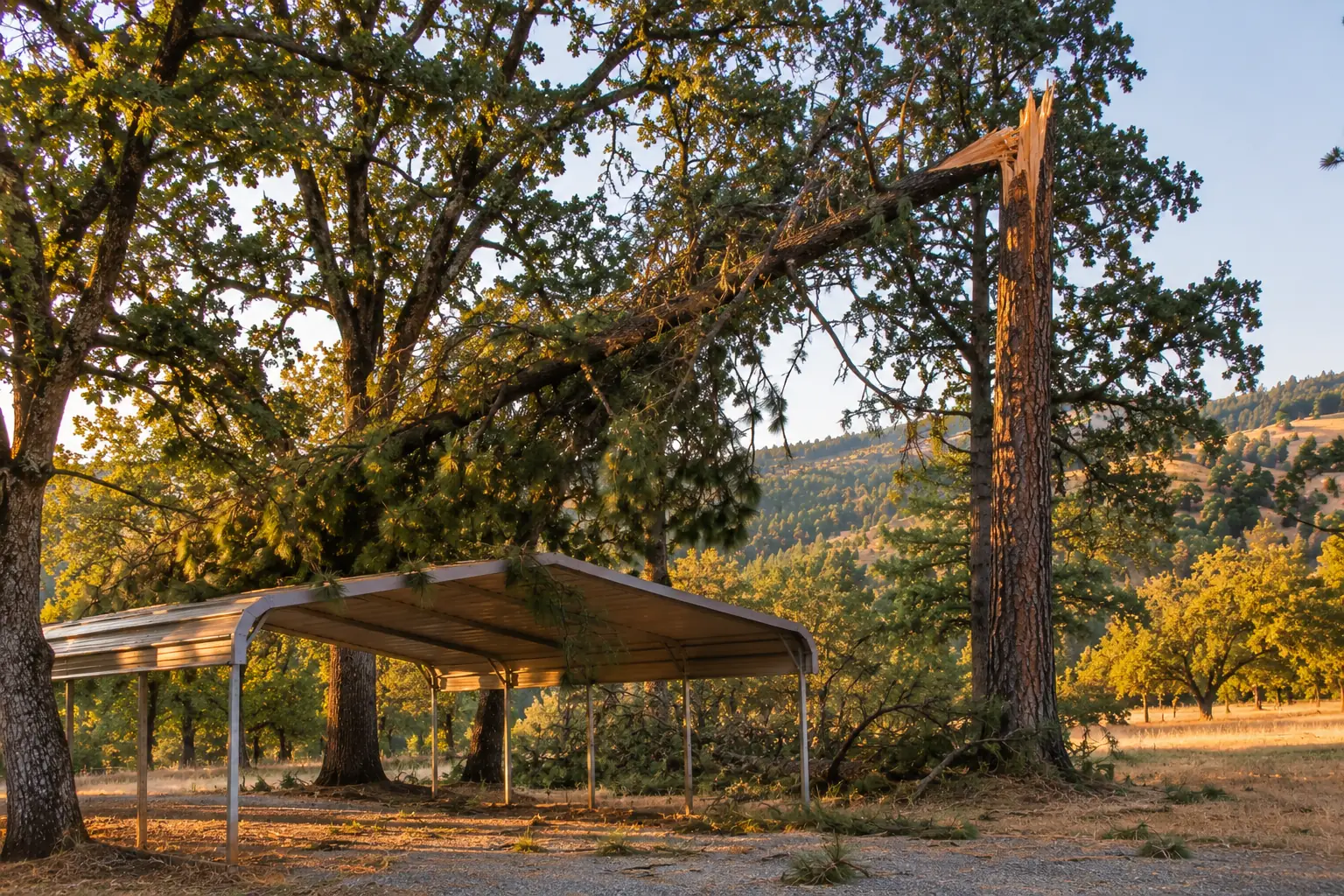
| A broken limb caught in the crown | A "widowmaker" that can drop at any time | Right away |
| Mushrooms or shelf fungus (conks) at the base or on the trunk | Internal decay | Within weeks |
| Bark falling off, no needles or leaves in season | A dead tree | Within weeks |
| Dead top, thin crown, or dieback from the tips | Decline from drought, insects or root problems | Soon, for an opinion |
| Pitch tubes or fine sawdust on a pine trunk | Possible bark beetle attack | Soon |
A pine whose needles fade from green to yellow or red deserves a closer look. The bark beetle guide explains what to look for, and the dead tree warning signs guide goes through more of the signs in this table.
What a hazard inspection involves
An inspection is a structured look at the tree, its site and its targets, and the best ones are done by someone trained for it. Ask for one of these people:
- An ISA Certified Arborist. ISA's homeowner sheet on pruning mature trees says certified arborists have passed a comprehensive exam and must keep up continuing education.
- An arborist with ISA's Tree Risk Assessment Qualification (TRAQ). ISA lists TRAQ as a qualification focused on assessing tree risk.
You can check a person's ISA credential with the ISA credential lookup. On site, expect the inspector to walk around the tree, look at the root zone and the trunk flare, sound the trunk with a mallet to listen for hollow spots, and look up into the crown for dead or hanging wood. For a large tree near a house, ask whether the company can give you a short written finding, especially if the tree is in a creek corridor where the city may ask for one.
Choices after the inspection
Not every hazard tree has to come down. Depending on the defect, a tree service may suggest one of these, in rising order of cost and finality:
- Watch it. Note the sign, take a dated photo, and look again after the next big storm.
- Clean the crown. Cut out dead, broken and hanging limbs. The trimming page describes this work.
- Reduce the weight. Shorten long, heavy limbs that reach over the roof or driveway.
- Support a limb. The Oregon Landscape Contractors Board's tree work FAQ lists guying limbs among the tree work a CCB license allows. Ask whether bracing or guying makes sense for your tree.
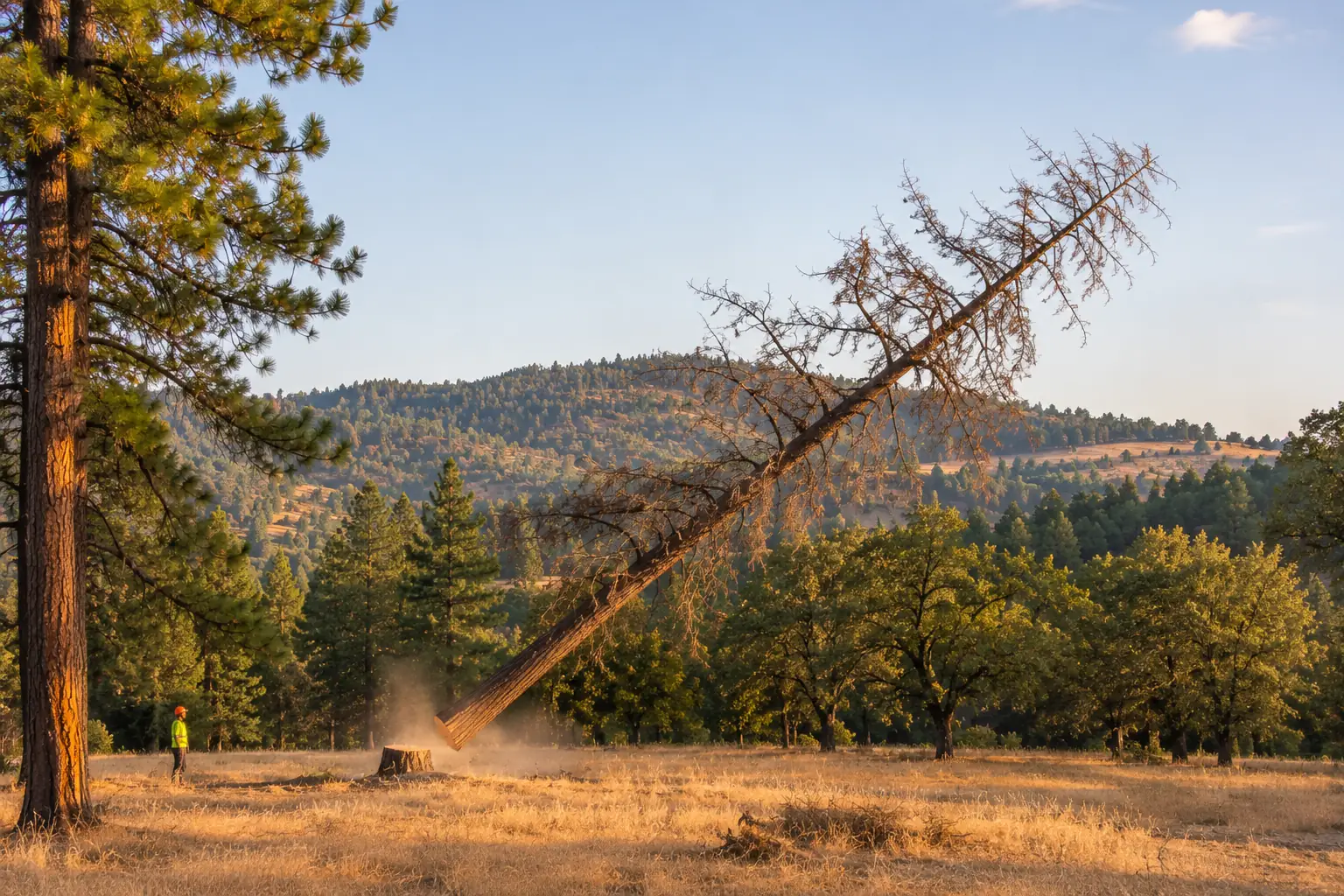
- Remove the tree. When the trunk, the roots or most of the crown is failing, removal is the safe answer. The removal page covers how it is done.
On rural acreage, a dead tree far from any target can sometimes be left standing as a wildlife snag. Ask the inspector whether yours is a good candidate, keeping in mind fire spacing around the house.
When the city can order a tree trimmed or removed
Inside Rogue River city limits, the street tree ordinance, Chapter 12.20, puts duties on owners of trees near public ways. Under section 12.20.140, anyone whose tree overhangs a street or other public way is expected to take out failing or unsafe trees on that frontage, along with any rotten or snapped branch that puts the public at risk. Section 12.20.150 goes further. If a dying or diseased tree on private land endangers people or buildings, the city may cut it itself or tell the owner to. An owner who has not acted 30 days after the city recorder's notice is in violation, and public works can then do the job and attach the bill to the property as a lien. Under section 12.20.160, the owner has 10 days after receiving an order to file a written appeal to the city council.
If you get a notice, call City Hall at (541) 582-4401, listed on the city website, and ask what the order covers and how long you have.
Hazard trees on a creek bank
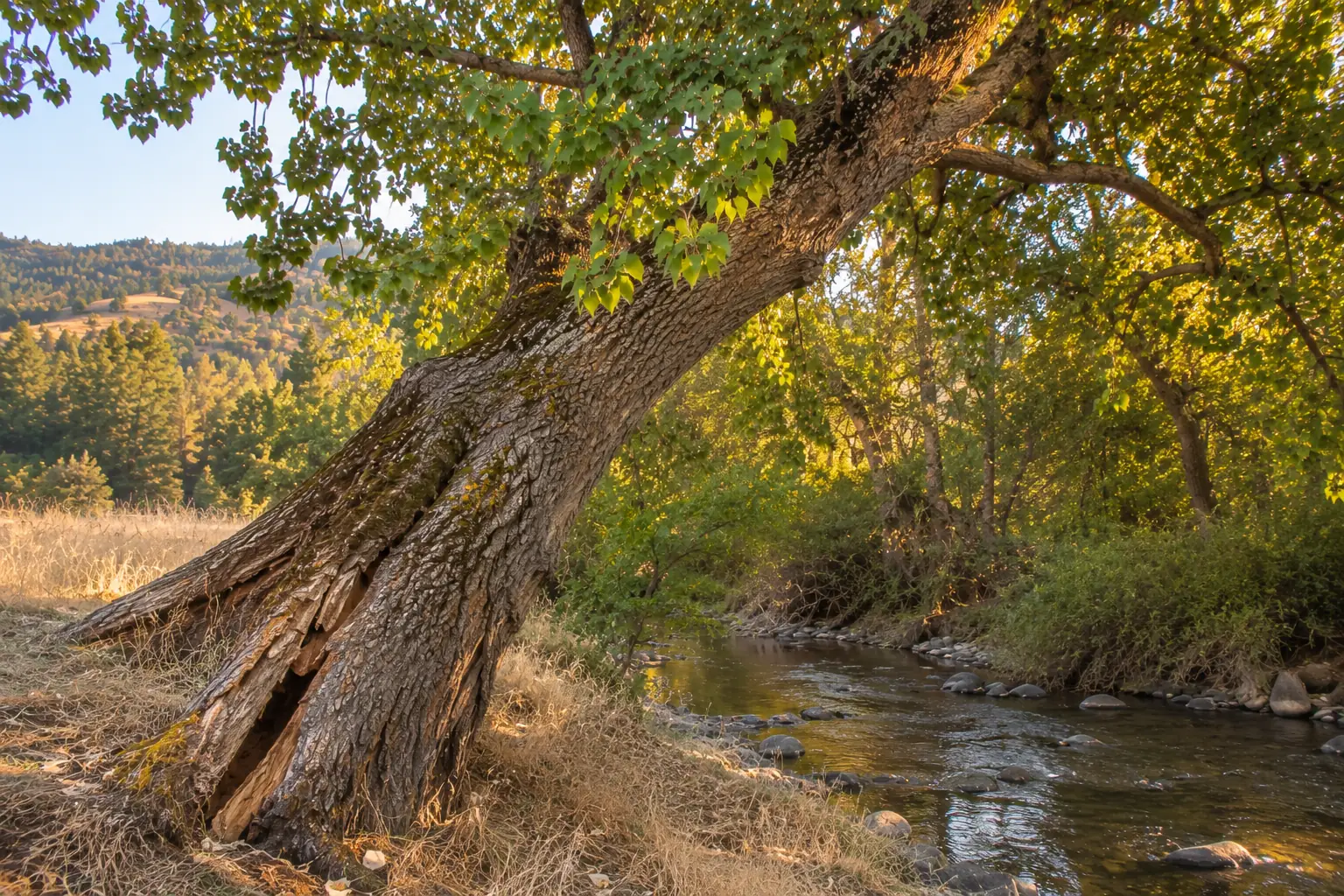
Removing a hazard tree beside the water takes an extra step. Inside the city, the riparian chapter covers land within 75 feet of the top of the Rogue River's bank and 50 feet of Evans Creek, Wards Creek and other fish-bearing streams. Under section 17.135.040, taking out a hazardous tree in that strip goes through city review first, with an exception for emergencies. The city administrator, or whoever that office assigns, can ask for a professional arborist's opinion paid for by the owner. Replacement planting with natives follows any removal, and the Jackson Soil and Water Conservation District's city guide describes the usual ratio as three native trees for each one removed.
Outside the city, the district's Jackson County guide applies the same setbacks. Call Jackson County Development Services at (541) 774-6900 before cutting inside one. A leaning cottonwood or alder that is not threatening anything may be better left to fall on its own along the bank. The city's riparian chapter lets downed trees stay in the corridor.
What hazard work costs
The price depends on what the inspection finds and what you decide to do. National removal guides give a sense of the spread:
- LawnStarter's tree removal cost guide, updated October 5, 2026, gives a typical range of $385 to $1,070 and says a dead or sick tree that is still stable may cost about the same as a healthy one. It also notes that difficult access can raise the bill by up to 50%.
- This Old House's cost guide, updated March 5, 2026, says diseased or damaged trees cost more, and lists $800 to $1,500 for trees 60 to 80 feet tall.
- For crown cleaning and weight reduction, LawnStarter's trimming guide, updated September 24, 2026, says damaged, unhealthy or dead trees cost more to work on.
A badly decayed tree can be too weak to climb, which may mean a lift or crane and a higher price. The written estimate after the inspection is the number to plan on. The cost guide covers more.
What to ask the company
Use these questions on the call and at the inspection:
- Who will inspect the tree, and do they hold ISA certification or TRAQ?
- What is the defect, and what is it likely to hit?
- Is there a choice short of removal, and how long would it buy?
- Will you put your finding in writing if the city asks for one?
- What is your CCB number? Look it up on the Oregon CCB license search.
- If the tree is near a power line, have you checked with Pacific Power at 1-888-221-7070?
If the tree has already cracked or fallen onto something, use the emergency page. The home page lists every service and the towns covered, including Shady Cove and Trail up the river.
Frequently asked questions
How do I know if a dead tree is dangerous?
Dead trees have a high potential for failure, according to OSU Extension. How dangerous one is depends on what it could hit. A dead tree near the house, a road or a play area should be looked at soon.
Can I make my neighbor remove a dangerous tree?
This site cannot give legal advice. Talk to your neighbor first and share photos. Inside the city, a dead or diseased tree that threatens life and property may be covered by section 12.20.150, so City Hall is one place to ask.
Does a leaning tree always need to come down?
No. Many trees grow with a steady lean. A lean that is new or getting worse, with roots lifting on one side, is the warning sign.
Is city approval needed for a hazard tree beside the creek?
Inside the riparian corridor in Rogue River, the city reviews hazard tree removals except in emergencies and requires native replacement planting. Outside the city, check with Jackson County.
What is an arborist?
An arborist is someone trained in the care of individual trees. An ISA Certified Arborist has passed ISA's exam and keeps up continuing education. Ask for the certification number and check it with ISA.